Home
Datup vs Microsoft Dynamics 365

Microsoft Dynamics 365: Features, Pricing and Reviews 2025

Microsoft Dynamics 365 for Supply Chain Management is one of the main options considered to optimize business operations due to its brand recognition in the market, but is it really the tool your company needs? Find out here everything you need to know if it's the ideal software for your company.
o9 Solutions Features

Comparison table between Datup and Microsoft Dynamics 365 (Supply Chain Management)

Feature Datup Modern AI Microsoft Dynamics 365
Main Focus Comprehensive retail platform with integrated modules for planning, inventory, purchasing, and distribution. Integrated AI assistant that responds within the platform and on WhatsApp. End-to-end supply chain ERP managing products, procurement, inventory, warehouses, production, logistics, and asset maintenance.
Implementation Time Less than 5 weeks FAST
Agile and flexible configuration, ideal for companies needing immediate results.
Typical implementations of 3–6 months for SCM modules, potentially extending to 9–18 months for large multi-module and multi-country projects.
Required Investment Competitive SaaS model, designed for scalable investment and rapid return without replacing the ERP. Per-user licensing and ERP implementation services; higher investment oriented towards comprehensive operational transformation.
AI/ML Technology Machine Learning that learns from your specific data. Models adapted to your business with continuous improvement. AlaIA Assistant. Integrated AI (including Copilot) for demand planning, inventory optimization, operational insights, and supply chain process automation.
Ease of Use Easy-to-adopt tool with AI assistant available 24/7. Intuitive interface designed for business users. Rich but more complex interface, with many entities and modules; requires training for operations, finance, and IT users.
Support Personalized support in Spanish. AI assistant answers questions on the platform and WhatsApp. Continuous local support. Global partner network and Microsoft support; multiple levels of enterprise support and extensive documentation.
Complexity Modern and agile solution. Does not require dedicated teams or external consultants for operation. Robust and complex platform that often becomes the core system; requires data governance, administration, and often specialized consultants.
Ideal Customer Profile Companies that value agility, innovation, and rapid results. Mid-to-large retail, consumer goods, or distribution companies that already have an ERP. Mid-to-large companies and corporations with multi-site operations needing a complete and scalable supply chain ERP, integrated with finance and other processes.

Microsoft Dynamics 365 for Supply Chain: Key Features

Supply chain management

Microsoft Dynamics 365 for the supply chain offers comprehensive features that facilitate the optimization and agility of decision-making at every link in the chain. In addition to demand forecasting capabilities, it offers:

  • In procurement, automates decisions, assesses vendor risks and facilitates secure additions with external catalogs and performance monitoring using Power BI.
  • In the production process, supports discrete, process and lean manufacturing with real-time views, IoT integration, mixed reality and cost analysis to reduce downtime and accelerate commercialization.
  • In logistics and warehouses, promises accurate deliveries integrating inventory and carrier data such as FedEx, automates picking, packing and reservations, and employs robots to increase efficiency.

Datup is a comprehensive Supply Chain Analytics platform with data integration capabilities from the different departments involved in the supply chain (demand, finance, sales, commercial). Datup revolutionizes supply chain management through advanced artificial intelligence that offers:

  • Demand forecasts with accuracy of up to 95% for Individual SKUs, Full Categories, and Each Channel or point of sale.
  • Visualization of multiple forecast scenarios in short, medium and long term horizons, incorporating external variables, seasonality patterns and market trends, in addition to estimating the demand for new products before launch.
  • In inventory optimization, Datup dynamically calculates safety stocks, reorder points and optimized lead times, automatically classifying the portfolio according to its impact, revenue, turnover and stability.

It offers centralized control panels which facilitates collaborative planning and efficient management of working capital, transforming complex data into actionable strategic decisions.

Demand planning and forecasting

Microsoft Dynamics 365 has demand planning features that include demand forecasts, material planning, capacity planning according to real-time variations in supply and demand, and inventory policies that dynamically adjust to stock levels.

In the same way, the Datup software it also includes demand forecasts of up to +95% accuracy, incorporating + 200 external variables that reinforce the analysis. In addition, do the Forecast demand by SKU, product category and location. It also processes up to 7 scenarios to optimize decision-making, and has a collaboration panel to coordinate demand with other key teams such as sales, finance and operations (S&OP). Another noteworthy feature of Datup is that before all the forecasts it performs the classification of inventory or portfolio, to prioritize SKUs in terms of profitability, rotation speed and stability of their demand.

Purchasing and supplier management and optimization

Microsoft Dynamics 365 for purchasing management offers a collaboration portal with suppliers, where you can manage contracts and monitor the performance of each partner in real time and quality. It also has administration for purchasing policies, automatically ensuring the costs agreed with the supplier. You can centralize all supplier and negotiation information in one place, so you can then analyze the data and make better procurement decisions.

With Datup You can also centralize your supplier information together with purchasing and procurement policiesor, it automatically calculates the Lead times and business rules To speed up Inventory reorders. Get to know the performance of your suppliers easily and quickly and avoid stock failures when possible delays occur.

Inventory optimization and logistics

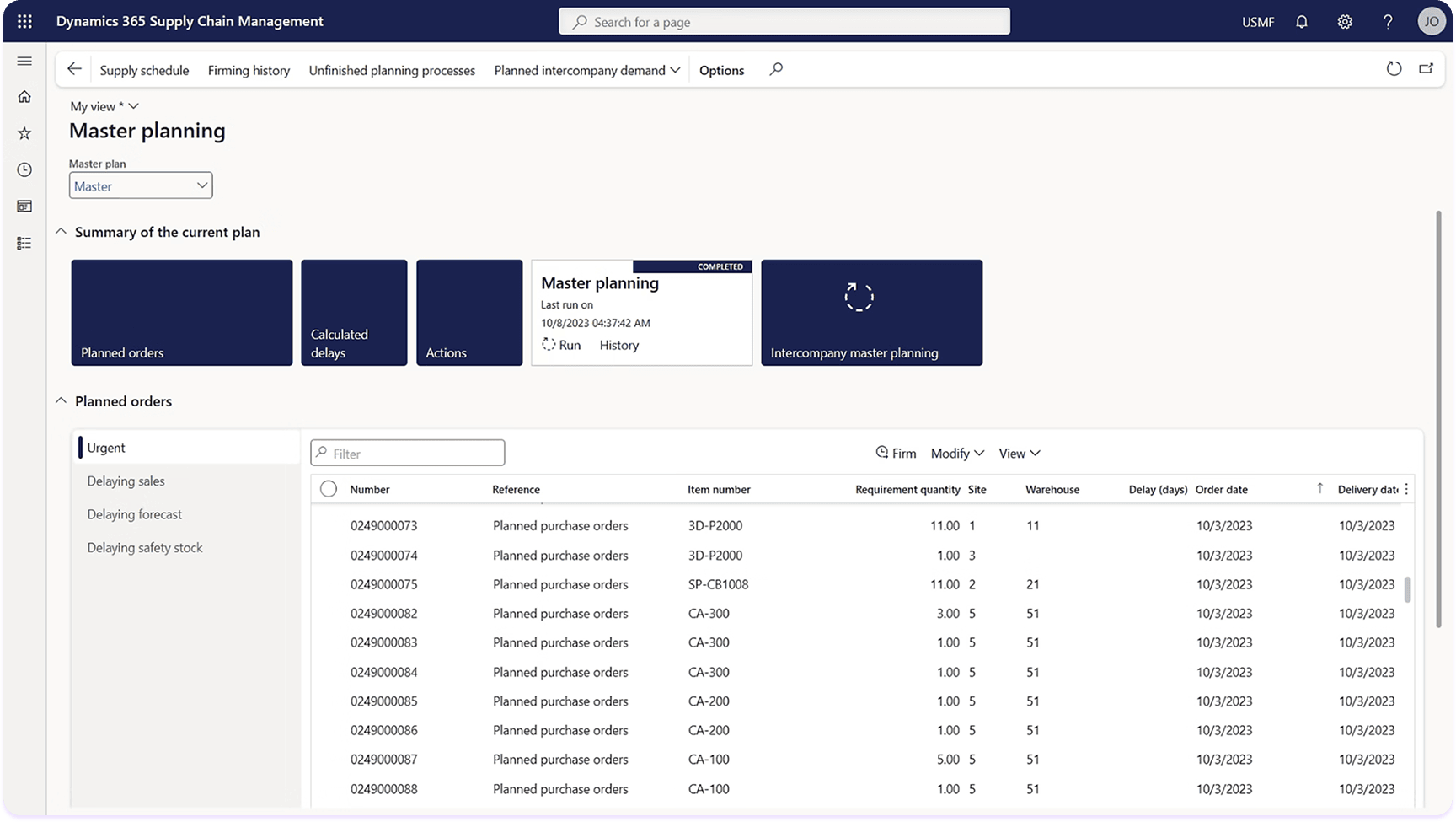
Microsoft Dynamics 365 Supply Chain Management it has an inventory module that allows you to view the stock in real time throughout the operating process, from reception to shipment. The g systemManage multiple warehouses with full traceability using batches and serial numbers. It includes automatic replenishment rules connected to the MRP, forecasts with AI to optimize stock levels, and processes such as cross-docking, picking and cycle counting via mobile app. It integrates with Warehouse Management for location control and code scanning, in addition to the quality module for inspecting and approving merchandise before release.

The module of Datup Inventory Optimization helps you maintain the balance between availability and financial efficiency. Datup automatically calculate your safety stocks, reorder points and lead times. In addition, classify your portfolio according to revenue, turnover and stability so you know exactly where to focus your efforts and resources. The system gives you Intelligently suggests when and how much to reorder, both by product and by specific location, optimizing distribution in all your CEDIS, warehouses and points of sale. You can easily visualize the history of your inventory levels and manage everything from a dashboard that gives you full visibility of your working capital. The best thing is that you receive early alerts when there is a risk of running out of stock or when you are accumulating excess inventory, allowing you to act on time and keep your operation running smoothly.

Pros and Cons of Microsoft Dynamics 365 and Datup

Software Pros Cons
Datup
  • 1. Fast implementation (less than 5 weeks) allowing for immediate results. SPEED
  • 2. Affordable investment with ROI in 3-6 months, not years.
  • 3. Integrated AI assistant available 24/7 on the platform and WhatsApp.
  • 4. Intuitive interface requiring no extensive training or dedicated technical teams.
  • 5. Personalized support in Spanish with continuous local attention.
  • 6. Comprehensive platform with fully integrated planning, inventory, purchasing, and distribution modules.
  • 1. Does not have modules to manage transport and distribution logistics.
  • 2. May require adaptation for extremely complex operations of large multinational corporations.
Microsoft Dynamics 365
  • 1. Scalability and native integration: naturally integrates with the rest of Dynamics 365, Microsoft 365, Power Platform, and Azure, scaling well for mid-to-large, multi-country, and multi-site organizations.
  • 2. Covers the entire supply chain end-to-end.
  • 3. Automation and productivity: automates workflows for planning, orders, warehouse, transport, and maintenance, reducing manual tasks, errors, and cycle times.
  • 4. End-to-end visibility and data-driven decisions: consolidates inventory, warehouses, purchasing, production, and logistics into a single platform with analytics and AI.
  • 1. Long implementation of 6-12 months that delays time-to-value. SLOW
  • 2. Total cost and implementation complexity: projects usually require significant investment in licenses, implementation services, and organizational change.
  • 3. Longer-term ROI: Return on investment in 12 months or more, due to the depth of the implementation.
  • 4. Learning curve and need for expertise: the functional breadth implies a considerable learning curve and high dependency on partners.

Main differences between Datup and Dynamics 365

Difference Datup Microsoft Dynamics 365
Implementation Time Speed Datup: Agile Implementation

Datup integrates with your ERP, WMS, and TMS systems in 4 to 8 weeks, allowing you to start optimizing inventories and getting results much faster than other market options.

No extra implementation costs
Slow Process Dynamics 365: Moderately Slow Implementation

A standard implementation usually ranges from 3 to 6 months, potentially extending to 9 to 18–24 months for large and complex projects.

ROI Short Term Datup delivers immediate value

Thanks to its rapid implementation, Datup generates ROI in 3-6 months.

Companies see inventory reduction of up to 30% from the first few months
Medium Term Dynamics 365: Slower ROI

The return on investment for Dynamics 365 usually starts to be clearly perceived between 12 and 24 months after go-live.

Complexity and Integrations Specialized Datup: Focused on Supply Chain

Datup focuses on demand forecasting, inventory analysis, reorder point definition, and purchase/replenishment recommendations using deep learning, scenarios (base/optimistic/pessimistic), and ABC/FSN/XYZ classification, integrating as an “AI layer” on top of existing ERP/WMS.

Greater than 95% accuracy in demand forecasting
More Complex Covers beyond the supply chain

Dynamics 365 SCM covers the entire business cycle: product management, planning, procurement, inventory, WMS, production, transportation, asset maintenance, sales, and costing, with integrated AI capabilities but within a complete transactional ERP.

Customer Profile Companies wanting to optimize planning without changing ERP Datup: Cloud SaaS Model

It is ideal for companies that already have an ERP (SAP, Dynamics, Oracle, or others) but want to improve forecast accuracy, optimize inventory levels, and reduce stockouts/excesses without changing their transactional system.

Focused on empowering entire supply chain teams
Upper mid-market and enterprise looking to renew operations platform ERP and CRM

It is more suitable for medium and large companies looking to unify and modernize their end-to-end operations platform (production, inventory, logistics, purchasing, sales).

When to choose Microsoft Dynamics 365 and when to choose Datup?

Datup is ideal for: Microsoft Dynamics 365 is ideal for:
Company Profile:
Medium to large companies looking to optimize inventory quickly
Retail and consumer goods companies needing accurate forecasting
Manufacturing requiring distribution optimization
Organizations needing short-term ROI (3-6 months)
Teams that value agile implementation and personalized support
Companies with products having expiration dates
Businesses seeking automation with a virtual assistant
Datup Success Stories:
Retail, consumer goods, and manufacturing companies have achieved up to 30% inventory reduction, improved availability, and reduced stockouts.
Company Profile:
Large corporations in sectors like consumer goods, retail, industrial manufacturing, automotive, among others.
Logistics operators, logistics companies, and companies with complex warehouse networks needing advanced WMS, automation, robotics, and fulfillment optimization.
Upper mid-market and enterprise organizations needing a specialized, scalable, and global supply chain ERP.
Companies with budget for long implementations.
Organizations that can wait 12-24 months for ROI.
Featured o9 Solutions Clients:
Retail, wholesale, and distribution managing large SKU volumes and multiple distribution centers.

Switching to Datup is easy

1

Connecting to your system

We identify the most efficient type of integration for your operation (API, Data Warehouse or files) and connect directly to your system or other key sources.

2

Structuring and training

We extract data from your system, structure it according to your operation, and train our AI models to deliver accurate and actionable recommendations.

3

Validation and start-up

We provide you with ready-to-use dashboards, with clear and actionable information. We validate with your team that the recommendations fit the operational reality and fine-tune the last details.

FAQs

What is the main difference between Datup and Microsoft Dynamics 365?

Microsoft Dynamics 365 is a comprehensive platform that can take into account more business areas (they can be added as your operation grows). Unlike Datup, which is an AI platform specialized in supply chain operation. Another important difference is the licensing model, since Dynamics 365 has a cost per user and contracted modules that usually increase the cost of entry. On the other hand, Datup has no user limit, it is a monthly subscription paid when you receive the first results and is calculated according to the complexity of your operation.

Is Datup cheaper than Microsoft Dynamics 365?

Indeed, Datup offers a more competitive licensing model than Dynamics 365. Datup has adaptable plans that allow developing companies to access innovative forecasting technology without making a large initial investment.

How long does it take to see results?

With Datup, organizations generally see concrete results 4 to 8 weeks after onboarding, due to its fast onboarding process. Dynamics 365, due to its higher level of complexity and requirement for advanced configurations, usually requires between 2 and 6 months for a full implementation.

Do both platforms integrate with ERPs?

Yes, both Datup and Dynamics 365 have integrations with the main ERPs in the market such as SAP, Oracle and others. Both platforms have pre-configured APIs and connectors that facilitate data synchronization.

Does Microsoft Dynamics 365 have a virtual assistant like Datup?

Not really, Dynamics 365 doesn't have a conversational virtual assistant comparable to AlAia. Microsoft has its Copilot conversational assistant, but it's not specifically trained for the supply chain, as is Datup's expert AI assistant.
Supply Chain Analytics
Datup integrates your data and uses deep learning to predict demand (95%+ accuracy), analyze your inventory, and calculate reorder points, prioritizing your purchases based on location and strategic products.
Thank you! Your submission has been received!
Oops! Something went wrong while submitting the form.
Untitled UI logotextLogo
Logo
Logo
© 2025, Datup.