🇺🇸
The best alternatives to Relex are: Datup, Anaplan, Coupa, SAP, Kinaxis, O9solutions, and Logility. Learn about the features, prices and reviews of each one in this list.
Although Relex Solutions has established itself as an undisputed reference in the optimization of the supply chain in Retail, the complexity of the markets in 2026 requires solutions that adapt to different operational realities. For many organizations, factors such as long implementation times or the need for integration with specific SERPs makes looking for an alternative not just a matter of cost, but of strategic fit and agility.
In this list, we look at the leading options that are transforming demand and inventory planning. From AI-powered platforms designed for accelerated return on investment to unified cloud ecosystems, we explore how these alternatives allow for more flexible visibility, helping you find the exact piece of technology your supply chain needs.
We write this based on our daily experience in the industry and on what our own customers tell us firsthand about what really works (and what doesn't). We don't recommend because we recommend, our goal is to optimize your operation and lower that working capital, so we will only tell you that a tool is the best if it really works. In addition, we research every update and change in the market so that you always have fresh and reliable information at hand.
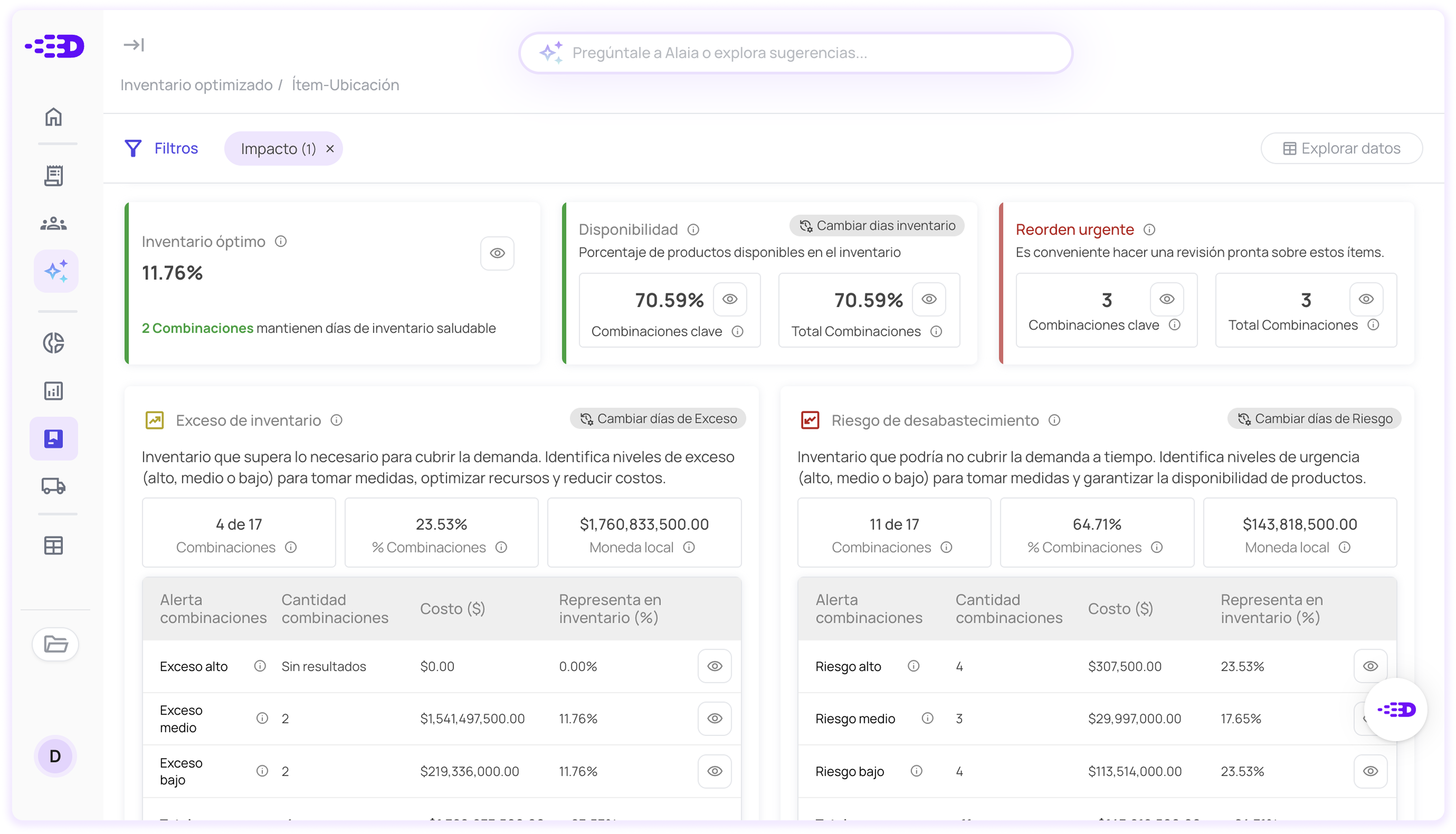
Datup is one of the most advanced supply chain software in the market, since its inception it has used AI technology to generate demand forecasts, optimize inventory and product portfolio, and inventory distribution to reduce excess stock, meet market needs, maximize service and generate savings in working capital.
It has an easy-to-use interface, fast integration, and a dedicated support team.
Thanks to its rapid adaptation to new technologies, Datup has features that adapt to different markets and operating sizes. His focus is on transforming supply chain data into actionable ones that help achieve business objectives such as demand planning, inventory optimization and portfolio distribution optimization at multiple points of sale.
Its key features include:
Unlike Relex, Datup usually requires a much lower initial investment as it is pure SaaS, compared to Relex projects that involve high amounts of licensing, services and customization. Like Relex, Datup is optimized to automate order and replenishment points based on security stock, lead times and business rules.
Datup operates with a transparent SaaS model focused on rapid adoption, with monthly subscriptions or that avoid the hidden costs of large consulting implementations.
Datup stands out if your priority is to improve forecast accuracy with AI and automate inventory replenishment in a matter of weeks. To find out a quote adapted to the needs and size of your company, you can talk to the sales team and learn more about this tool.
![Anaplan: funcionalidades, opiniones y precios [2025]](https://cdn.prod.website-files.com/67aa77fdde6ccbbc569579f4/695d5956aca0e24cfdc24894_6925bfa9bb011982d463442f_anapla-software-cadena-de-suministro%2520(1).jpeg)
Anaplan's greatest value is its flexibility. This platform is not a specialized retail solution, but rather an environment in which organizations can build their planning processes, connecting supply chain, with finance, sales and other areas. When planning cannot be solved solely from an operational logic, Anaplan offers a solution.
In practice, Anaplan offers another user experience and makes it easier to make other types of decisions.
Anaplan, with its Hyperblock engine, can support complex multidimensional models in memory, allowing us to recalculate scenarios and maintain consistency between different areas of the business. Its focus is on allowing users to build and modify custom models without writing code.
Some of the features it has include:
These functionalities manage to represent very specific processes, but for that they require that rules, assumptions and logics that are already incorporated in Relex be explicitly defined.
Anaplan's main advantage over Relex is the freedom to define how it plans and delivers, which is especially valuable in companies where financial planning is as important as operational planning. Anaplan can:
This approach, while sacrificing automation processes, favors alignment between different areas.
Greater flexibility means greater complexity. Anaplan does not have specialized algorithms for retail, inventory optimization or promotions, so the results will depend on the talent available to design the model. In other words:
If speed and process automation are prioritized, Relex is a more direct path.
Anaplan has a SaaS model based on the number of users and capacity, so there is a great variability in costs depending on the scope you seek to have.
The initial cost may be lower than that of Relex, but it can also grow with complex deployments.Anaplan provides great flexibility, superior to several alternatives, and the possibility of modeling unique processes, but for this it must rely heavily on the experience of the internal agents involved. In addition, it lacks retail capabilities as specialized as those of Relex.
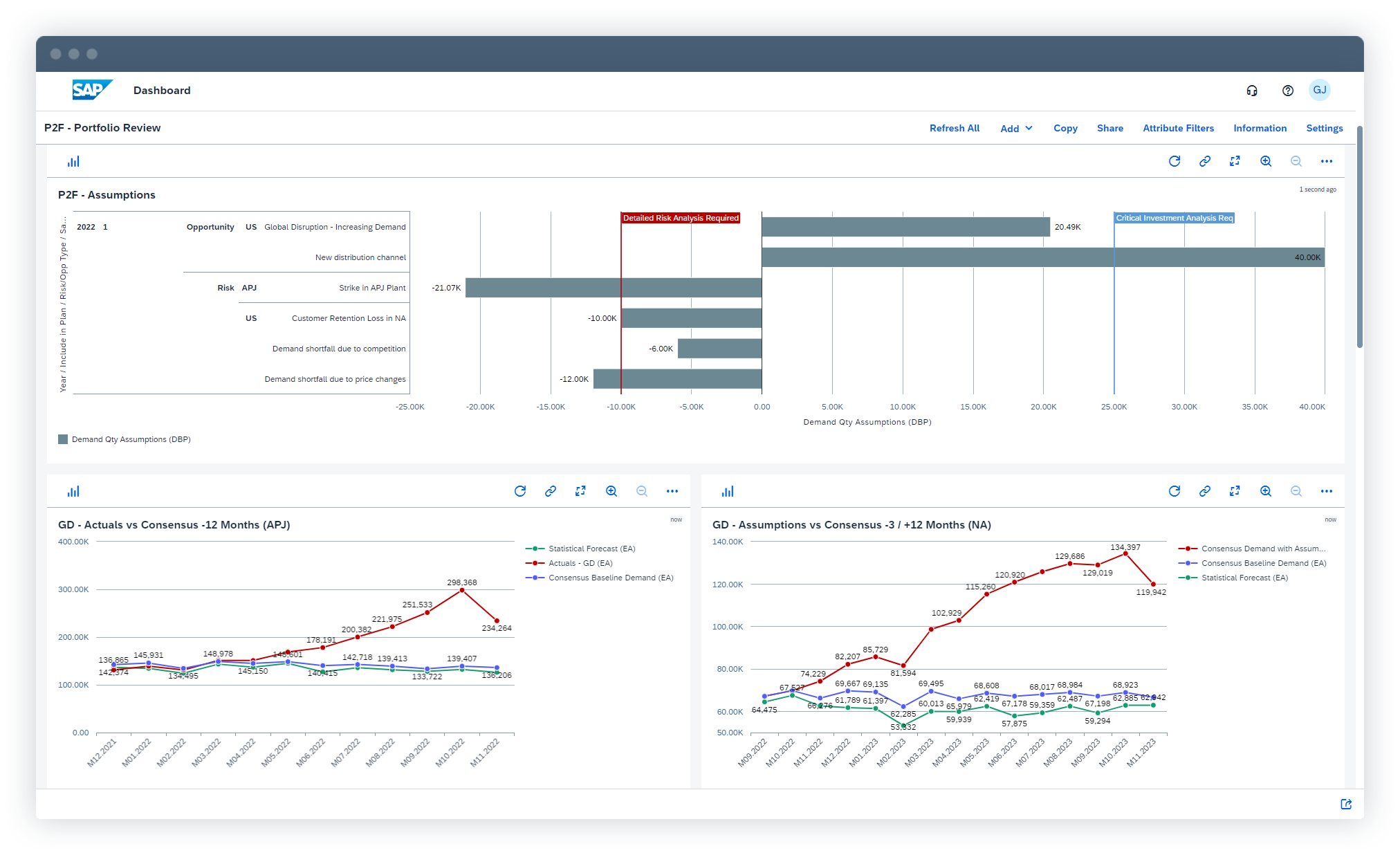
SAP Integrated Business Planning (SAP IBP) is the most obvious alternative when the company is already operating within the SAP ecosystem. His proposal, rather than solving a specific retail planning problem, seeks to become a corporate integrated planning system, connecting demand, supply and finance under the same logic of data and management.
In this sense, SAP is more than a tactical replacement for Relex, it is a long-term strategic decision, especially for companies where end-to-end consistency is valued more than speed of deployment.
SAP IBP stands out for covering the entire planning cycle, from demand forecasting to supply planning and financial S&OP. And it does it all with deep integration into the core ERP. Its strength lies in the robustness of the model and its ability to scale without degrading the most complex environments. Its main features include:
These features promote consistent, yet less flexible, corporate planning.
The main advantage of SAP IBP compared to Relex is the full integration with the SAP ecosystem and the financial planning incorporated from the original design, which translates into:
This approach is valuable when companies are looking for a single source at the corporate level and already have mature SAP teams.
SAP IBP, however, also involves significant complexity that is not compatible with contexts that want to be more agile.
In companies looking for quick results or greater operational adaptability, Relex may be a more efficient option.
SAP IBP is among the options with the highest total cost of ownership in the market. Your investments vary:
The high cost can be justified if SAP is already an essential part of the company's technological equipment.
SAP is positioned as the most complete option for companies that already work with the SAP ecosystem, since it offers deep integration and financial planning connected to the process. However, we must not lose sight of the high costs and their lack of agility in the face of rapid changes.

Kinaxis Maestro (RapidResponse) is a tool designed for companies that operate in complex environments with high volatility, where speed of reaction is key. Its biggest differentiator is its capacity for concurrent planning: in other words, any change is instantly propagated to all plans, without batch cycles.
Unlike Relex, which optimizes specific processes, Kinaxis focuses on fully synchronizing the supply chain and quickly simulating complex scenarios.
The Kinaxis engine is aimed at recalculating plans in real time in the face of any variation in demand, supply or capacity. It does this through:
These features make it possible to evaluate the impacts and available alternatives in seconds, something difficult to achieve with more traditional approaches.
Kinaxis differs from Relex because of the speed and depth of its simulation because:
It's especially strong in highly interconnected manufacturing industries and global supply chains.
However, the technical sophistication of Kinaxis has associated costs.
In retail, Relex usually offers a better relationship between specialization and effort.
The Kinaxis cost model is an enterprise model without retail pricing that varies depending on the deployment that needs to be done.
Kinaxis stands out for its concurrent planning and its capacity for real-time simulation, which makes it the ideal option for complex and volatile supply chains, but it requires a high initial investment and a considerable and constant learning curve.

o9 Solutions seeks to position itself as an AI-based integrated business planning (IBP) platform that seeks to break traditional silos and connect demand, supply, sales and finance in a single decision-making environment.
o9 Solutions has a Digital Brain that centralizes both internal and external data to feed its advanced planning and simulation models. It achieves this thanks to the following features:
These functionalities allow decisions to be made and analyzed in a transversal way and in greater depth.
o9 Solutions stands out when planning needs to integrate multiple dimensions of the business. Compared to Relex, it expands the scope of planning far beyond the operational supply chain. Some of the advantages it offers are:
This tool is a great alternative for large and diversified companies.
The breadth it offers, however, also implies greater complexity. For example:
If the focus is on demand and inventories, Relex is a better option, as it tends to be more direct and efficient.
o9 Solutions uses a modular SaaS pricing model, with prices that vary in the following ranges depending on the size of the organization.
o9 Solutions is an intermediate option between both worlds, since it combines demand planning, supply and finance with a strong focus on AI and integrated scenarios. However, this involves a high cost and a large adoption effort compared to enterprise-level solutions.
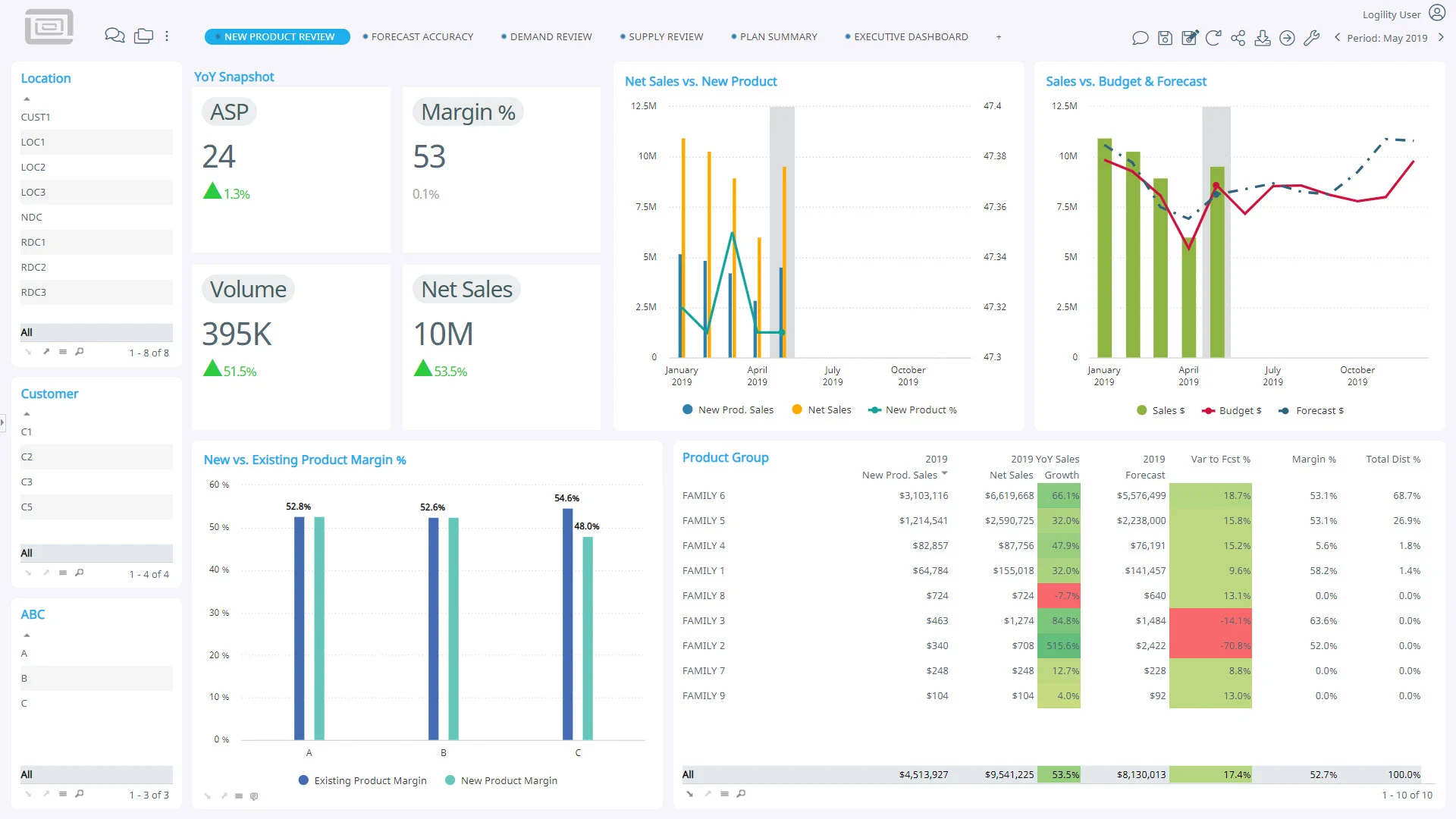
Logility is one of the supply chain planning platforms with one of the most conservative proposals. It focuses primarily on stability, functional maturity and cost control, and is positioned as a solid solution for companies that prioritize predictability. It's ideal when the goal is to professionalize planning without embarking on a large scale digital transformation.
Logility fulfills the basic functions of planning without major complexities. It does this through the following functionalities:
These functionalities are sufficient for many environments when seeking to standardize processes, improve planning discipline and gain operational visibility.
Logility is a simpler and cheaper alternative, with an attractive proposition when prioritizing risk reduction, implementation complexity and a more predictable operation. It has:
It is suitable when the objective is to progress without requiring a large technical team.
Logility is less advanced, has a more conservative approach, less sophistication in automation, and a more gradual pace of innovation, making it impractical for dynamic or omnichannel operations.
These limitations weigh when the business requires quick answers.
Its average cost is lower than Relex and is made with annual contracts. It is more predictable in its total cost, ideal for when looking to control investment and there is no need to assume sophisticated licensing or deployment.
Logility It is the most conservative and accessible alternative, ideal for companies that prioritize stability, predictability and cost control, but it achieves this by sacrificing sophistication.
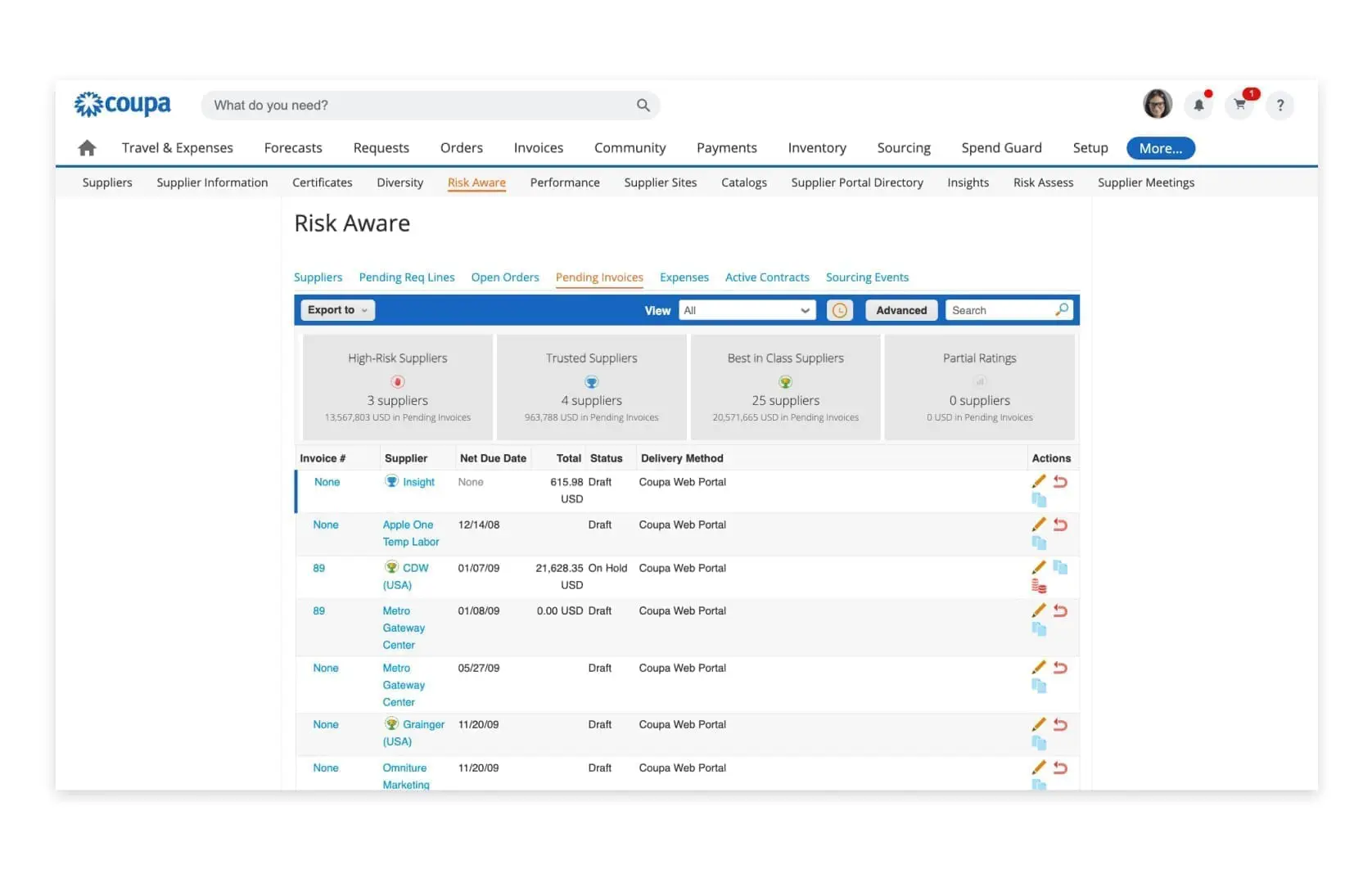
Coupa has its origin in the world of Business Spend Management and has extended its proposal to the planning and visibility of supply chains. Its focus is on integrating supply decisions, with inventories and suppliers within a financial logic of expense control.
For this reason, it is positioned as an alternative to Relex in cases where supply chain planning is conditioned by procurement, costs and the relationship with suppliers.
Coupa prioritizes visibility, control and financial analysis over deep algorithm optimization. It offers:
These functionalities allow us to understand the economic impact of operational decisions.
The strength of Coupa compared to Relex is that it offers a cross-sectional view of the business. Paying attention to:
It's an ideal choice when seeking to align operational efficiency with financial control.
Coupa is not intended as an advanced retail solution, as it has some peculiarities:
In this sense, Relex is a better option, and if you are looking for a transverse view, Coupa stands out as an alternative.
Coupa has an enterprise SaaS model with no costs exposed to the public, which are generally associated with multi-year contracts and sets of modules.
Coupa stands out if the focus is on the design and optimization of the logistics network, but also on structural cost reduction. However, it can be excessive if the main problem to be solved is the daily execution of demand and inventory.
To choose an alternative to Relex, we must start from an assessment of the context of each company. Not all companies have the same complexity, nor do they have the same objectives when looking for an alternative for their planning platform. Therefore, rather than looking for “the best tool”, it is necessary to identify which one best fits the needs of the business.
In practice, the decision must take into account a combination of structural and strategic factors, such as:
In addition, it is necessary to define What results are expected of change: Are you looking to improve forecast accuracy, reduce inventory, gain visibility, accelerate decision-making? or to standardize processes?
There is no single, superior alternative to Relex; the best choice is one that can balance each company's functionality, cost, and capacity for internal adoption.
As for the cost of entry, Datup, Anaplan and Logility are the most accessible options.
However, the final price of each tool will depend on the scope of its implementation.
In this regard, costs may vary depending on:
Anaplan can be competitive in limited projects and continue to grow if necessary. Logility, on the other hand, offers a more predictable cost structure. You always have to evaluate the total cost of ownership and not just the starting price.
Often, making this change is an opportunity to review the quality of the data and the way in which decisions are made.
The migration process usually has several stages:
Tools with approaches closer to those of Relex make the transition easier, while platforms with different models require greater management and training.
The best alternative for advanced inventory optimization depends on the size and complexity of the operation. SAP IBP stands out as the option with the greatest technical depth thanks to its Multi-Echelon (MEIO) optimization functionality; on the other hand, Datup is positioned as the leading alternative for those looking for high precision results through Advanced AI with a key competitive advantage: an agile implementation of just 5 weeks, ensuring an accelerated return on investment (ROI) and greater operational agility compared to traditional corporate suites.