Home
Datup vs Kinaxis

Kinaxis: what it is, features and reviews

Kinaxis is a software for supply chain management aimed at large companies. Learn everything Kinaxis offers and if you should consider it for your company.
o9 Solutions Features

Comparison table between Datup and Kinaxis

Feature Datup Modern AI Kinaxis
Functions Demand forecasting, inventory and distribution optimization, inventory balancing, shortage management, expiration date control and storage constraints, ERP and WMS integration. Demand and supply planning, inventory management, risk monitoring, supply chain orchestration.
Implementation Time 4 to 8 weeks FAST
Agile and flexible configuration, ideal for companies needing immediate results.
8 to 18 months, depending on the company's complexity.
Required Investment Competitive and scalable pricing model. Return on investment (ROI) in months, not years. Multi-million investment. Requires a robust budget and ROI may take years.
AI/ML Technology Deep learning + ML using >200 external variables (inflation, weather, etc.) for forecasting and inventory/reorder suggestions; AI heavily focused on demand/inventory. Planning.AI engine + Maestro agents for scenarios, optimization, alerts, and workflow automation across the entire chain.
Ease of Use Easy-to-adopt tool with 24/7 AI assistant. Intuitive interface designed for business users. Requires extensive training and specialized technical personnel for daily operation.
Ideal Client Profile Mid to large-sized companies wanting to accelerate results in forecasting and inventory with an agile project. Large enterprises (typically >1000 employees and >$500M revenue) in manufacturing, electronics, automotive, pharma, etc.
Key Strengths High automation of forecast and inventory, business-oriented interface, rapid deployment, and focus on tactical KPIs (stockouts, excess, frozen capital). Concurrent planning, functional breadth, and end-to-end orchestration with advanced scenario capabilities and cross-functional collaboration.

Kinaxis: Key Features

Supply chain management

Kinaxis offers its Supply Chain Orchestration solution, This solution encompasses the optimization of the supply chain from start to finish, connecting demand, inventory, capacity, transportation and customer service, this helps to unify data and improves decision-making. It offers:

  • Concurrent planning and scenarios, allows several teams to work on the same model with planning, capable of hypothetical scenarios that allow us to evaluate sudden changes in the chain.
  • Orchestration of processes and workflows: incorporates exception workflows, business rules and collaborative spaces to coordinate decisions between demand, supply, finance, logistics and external partners, capturing decisions, approvals and tasks on the same platform.
  • Integrated visibility, consolidates demand, supply, inventory, production, orders and transportation data into a “control tower” with comprehensive visibility, real-time alerts and impact analysis to react to disruptions in seconds.

Datup is a comprehensive Supply Chain Analytics platform with data integration capabilities from the different departments involved in the supply chain (demand, finance, sales, commercial). Datup revolutionizes supply chain management through advanced artificial intelligence that offers:

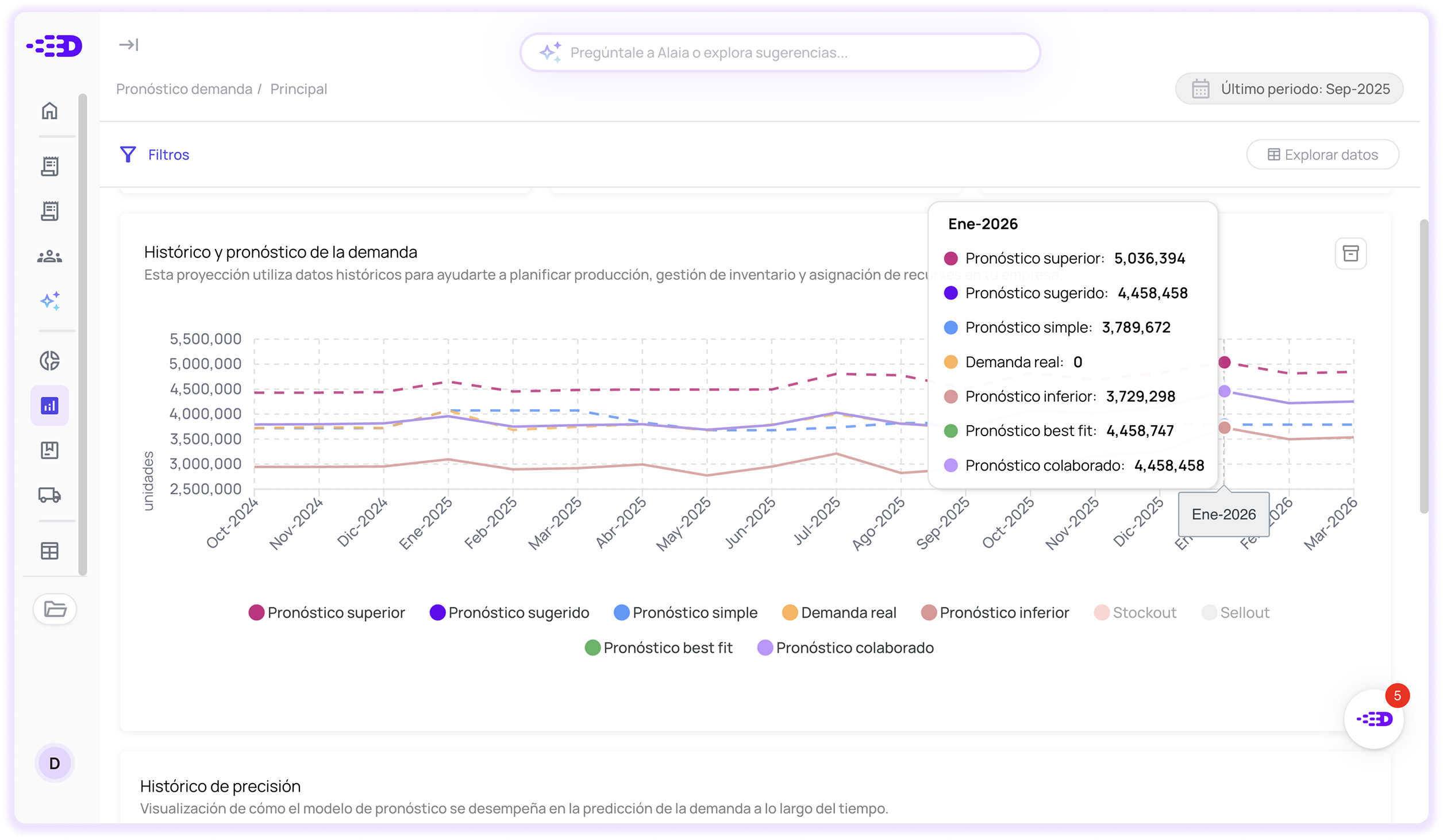
  • Demand forecasts with accuracy of up to 95% for Individual SKUs, Full Categories, and Each Channel or point of sale.
  • Visualization of multiple forecast scenarios in short, medium and long term horizons, incorporating external variables, seasonality patterns and market trends, in addition to estimating the demand for new products before launch.
  • In inventory optimization, Datup dynamically calculates safety stocks, reorder points and optimized lead times, automatically classifying the portfolio according to its impact, revenue, turnover and stability.
  • It offers centralized control panels which facilitates collaborative planning and efficient management of working capital, transforming complex data into actionable strategic decisions.

Demand planning

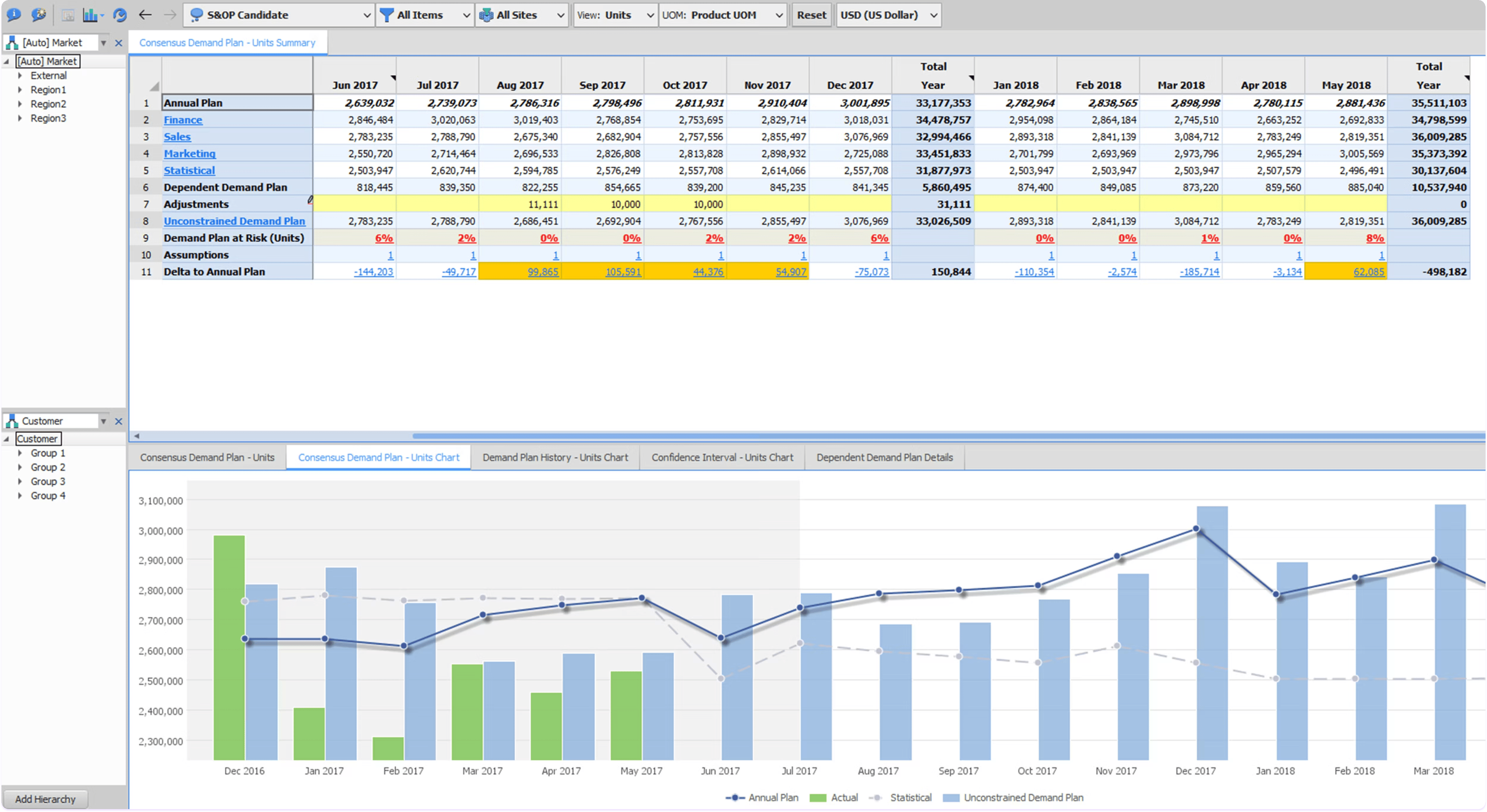
Kinaxis has functionalities for demand planning, that help automate the planning process. These include accurate forecasts with machine learning, short-term demand detection, collaborative demand planning, use of internal and external data for forecasting, segmentation of products according to their impact (ABC, volatility, margin).

In the same way, the Datup software It also includes demand forecasts of up to +95% accuracy, incorporating + 200 external variables that reinforce the analysis. In addition, do the Forecast demand by SKU, product category and location. It also processes up to 7 scenarios to optimize decision-making, and has a collaboration panel to coordinate demand with other key teams such as sales, finance and operations (S&OP). Another noteworthy feature of Datup is that before all the forecasts it performs the classification of inventory or portfolio, to prioritize SKUs in terms of profitability, rotation speed and stability of their demand.

S&OP and collaboration

The Kinaxis Sales & Operations Planning solution seeks to align sales, operations and financial decisions on the same plan in near real time, using simultaneous planning, scenarios and cross-functional collaboration to reduce risks, shorten the S&OP cycle and improve business results.

With Datup, also has S&OP collaboration, through a collaboration panel where, together with other teams such as marketing, sales, finance, and operations, they can plan together. This contributes to collaborative decision-making and breaks down silos between areas that hinder chain efficiency.

Multilevel Inventory Management

Kinaxis Inventory Management seeks to optimize inventory levels across the network using real-time insights and AI capabilities to reduce stockouts, minimize excess, improve inventory quality and accelerate decision-making.

  • Proactive Inventory Risk Management: identifies inventory risks and opportunities in advance, allowing policies and levels to be adjusted to maintain optimal stock and prevent disruptions.
  • Inventory quality monitoring: incorporates advanced metrics to assess “health” of inventory (excess, obsolete, coverage, turnover) and support corrective actions

The module of Datup Inventory Optimization helps you maintain the balance between availability and financial efficiency. Datup automatically calculate your safety stocks, reorder points and lead times. In addition, classify your portfolio according to revenue, turnover and stability so you know exactly where to focus your efforts and resources.

  • The system gives you Intelligently suggests when and how much to reorder, both by product and by specific location, optimizing distribution in all your CEDIS, warehouses and points of sale.
  • You can easily visualize the history of your inventory levels and manage everything from a dashboard that gives you full visibility of your working capital.
  • You receive Early Alerts when there is a risk of running out of stock or when you are accumulating too much inventory, allowing you to act on time and keep your operation running smoothly.

Pros and Cons of Kinaxis and Datup

Software Pros Cons
Datup
  • 1. Rapid implementation (under 5 weeks) allowing for immediate results. SPEED
  • 2. Accessible investment with ROI in 3-6 months, not years.
  • 3. Integrated AI assistant available 24/7 on the platform and WhatsApp.
  • 4. Intuitive interface requiring no extensive training or dedicated technical teams.
  • 5. Personalized support in Spanish with continuous local attention.
  • 6. Comprehensive platform with fully integrated planning, inventory, purchasing, and distribution modules.
  • 1. May require adaptation for extremely complex multinational operations.
  • 2. Does not function at 100% without at least 2 years of historical data.
  • 3. Not ideal for companies that do not yet have developed planning processes.
Kinaxis
  • 1. Concurrent planning and simulation speed: allows multiple planners to work on simultaneous scenarios, with impact simulations in minutes instead of slow batch cycles.
  • 2. Advanced machine learning algorithms for global enterprise-scale operations.
  • 3. Good fit for complex networks: especially valued in industries like automotive, high-tech, and pharma, characterized by high complexity, long lead times, and multi-echelon structures.
  • 4. Infrastructure designed to handle highly complex and multi-country operations.
  • 1. Long implementation of 8-18 months, delaying time-to-value. SLOW
  • 2. Initial investment of millions of dollars, out of reach for many companies.
  • 3. Requires dedicated technical teams and external consultants for implementation and operation.
  • 4. Learning curve and UX: various users note it is not very friendly for new users, with a complex interface and a need for dedicated specialists.
  • 5. Less "AI-first" than some competitors: although it incorporates AI, some reviews perceive it as strong in classic planning and simulation, but less automated than newer native AI solutions.

Main differences between Datup and Kinaxis

Difference Datup Kinaxis
Implementation Time Speed Datup: Agile Implementation

Datup integrates with your ERP, WMS, and TMS systems in **4 to 8 weeks**, allowing you to start optimizing inventory and getting results much faster than other market options.

No extra implementation costs
Complexity Kinaxis: Complex Implementation

Kinaxis requires **8 to 18 months** for implementation due to its need for deep adaptation to each business. This implies greater consulting resources and internal team time.

Company Type and Usage Mid to Large-sized Companies Datup delivers immediate value

Datup targets mid to large-sized companies wanting rapid results in stockouts, excess, and frozen capital, with implementation in weeks.

Companies see up to 30% reduction in inventory from the first few months
Large Corporations Kinaxis focuses on complex chains

Kinaxis is geared towards large global corporations with complex chains, multiple plants and ERPs, and mature S&OP/IBP processes.

Complexity, Cost, and Time-to-Value Flexible Datup: SaaS with flexible subscription

Monthly subscription model accessible from the cloud, without the need for large initial investments.

Ideal for mid-sized companies seeking scalability without compromising the budget
Licenses Kinaxis: Higher Investment

Kinaxis implies longer transformation programs, higher investment, and a steeper adoption curve, but with structural impact on how decisions are made globally.

When to choose Kinaxis and when to choose Datup?

Datup is ideal for: Kinaxis is ideal for:
Company Profile:
Mid to large-sized companies looking to optimize inventory quickly
Retail and consumer goods needing precise forecasting
Manufacturing requiring distribution optimization
Organizations needing short-term ROI (3-6 months)
Teams that value agile implementation and personalized support
Companies with products having expiration dates
Businesses seeking automation with a virtual assistant
Datup Success Stories:
Retail, consumer goods, and manufacturing companies have achieved up to 30% inventory reduction, improved availability, and reduced stockouts.
Company Profile:
Organizations with already structured S&OP/IBP processes
Automotive, high-tech/electronics, and semiconductor sectors
Large enterprises with global networks, multiple plants, complex contracts, and various ERPs
Companies with budget for long implementations
Organizations that can wait 12-24 months for ROI
Notable Relex Clients:
Ford, Toyota, and Samsung, enterprise organizations with highly complex supply chains.

Switching to Datup is easy

1

Connecting to your system

We identify the most efficient type of integration for your operation (API, Data Warehouse or files) and connect directly to your system or other key sources.

2

Structuring and training

We extract data from your system, structure it according to your operation, and train our AI models to deliver accurate and actionable recommendations.

3

Validation and start-up

We provide you with ready-to-use dashboards, with clear and actionable information. We validate with your team that the recommendations fit the operational reality and fine-tune the last details.

FAQs

What is the main difference between Datup and Kinaxis?

Kinaxis is a tool that focuses on very complex chain networks, therefore, it is aimed at the enterprise, contemplates slower implementation times and return on investment, in addition to being a much more expensive tool. Datup is an agile implementation tool aimed at companies with a turnover of more than 10M USD, with available historical data that can be adapted to the complexity of the operations.

Is Datup cheaper than Kinaxis?

That's right, Datup offers a more accessible licensing model than Kinaxis. Datup offers adaptable plans that allow growing companies to access cutting-edge forecasting technology without making a significant investment.

How long does it take to see results?

Using Datup, companies usually obtain the first tangible results 4 to 8 weeks after start-up, thanks to its agile implementation methodology. Kinaxis, due to the depth of its architecture and the requirement for advanced configurations, usually needs 12 to 24 months to fully deploy.

Do both platforms integrate with ERPs?

Yes, both Datup and Kinaxis have integrations with the main ERPs in the market such as SAP, Oracle and others. Both platforms have pre-configured APIs and connectors that facilitate data synchronization.

Does Kinaxis have an AI assistant like Datup?

Yes, Kinaxis has AI Agents throughout all its modules. Datup has AlAia, your Supply Chain assistant who analyzes your data in real time, analyzes problems and proposes solutions.
Supply Chain Analytics
Datup integrates your data and uses deep learning to predict demand (95%+ accuracy), analyze your inventory, and calculate reorder points, prioritizing your purchases based on location and strategic products.
Thank you! Your submission has been received!
Oops! Something went wrong while submitting the form.
Untitled UI logotextLogo
Logo
Logo
© 2025, Datup.