🇺🇸
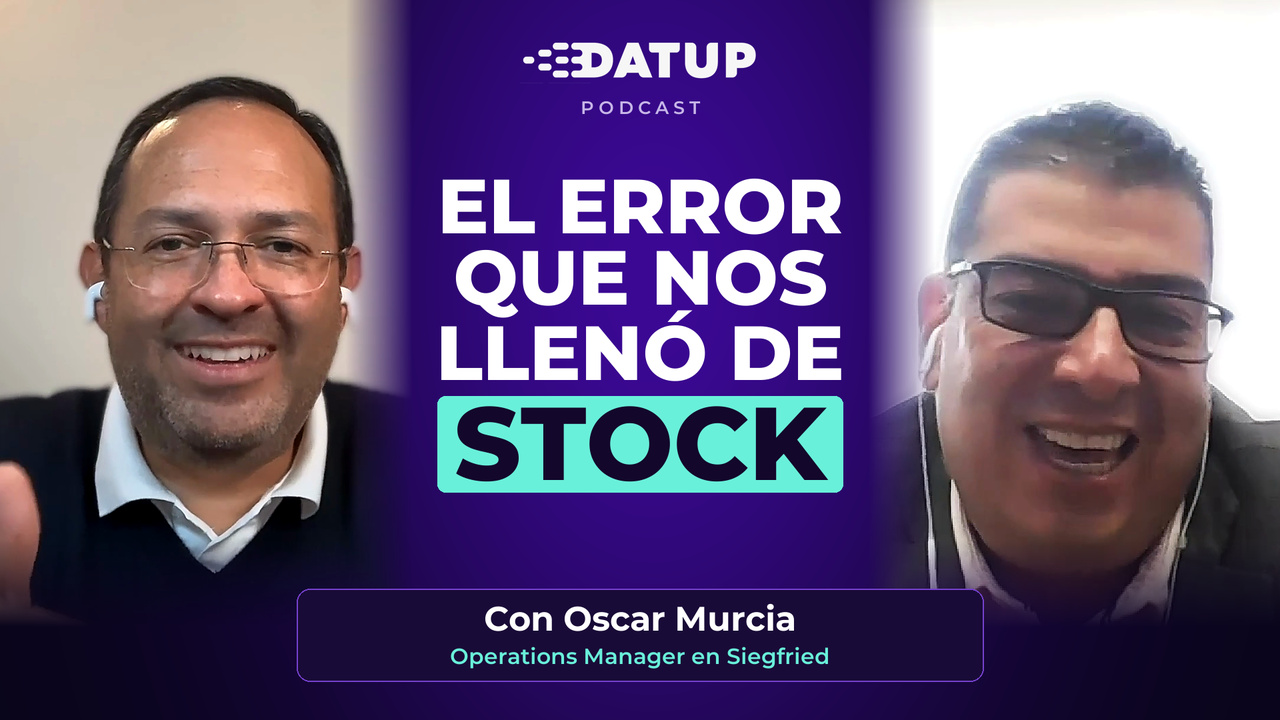
We’re launching a new space to talk to supply chain leaders about something completely different: the day-to-day, what’s actually happening on the ground. In this first episode, Felipe Hernández talks with Óscar Fabián Murcia Soriano, Operations Director at Siegfried: a pharmaceutical chemist with over twenty years in the industry and, as Felipe puts it, "one of our own."
They discussed the mistake that taught him the most, why money is the universal language between departments, artificial intelligence and quality of life, and what happened at the lab when they implemented Datup.
Felipe: What has been the biggest mistake you’ve made as a supply chain leader? What’s happened to you where you thought, "Oh no, that was a huge mistake"?
Óscar: I think one of the most significant ones—and you always learn from experience—is trusting a forecast that seemed solid but never was. And what happened there? Well, we ended up with an overstock of raw materials, had to start reviewing an action plan, and had to bring in other areas of the company to figure out how we could mitigate the problem we had created.
So, the big mistake we made was believing in a forecast and not following up on it.
Felipe: Why do you think people trust forecasts like that without really having a solid foundation?
Óscar: I think it was a dynamic many companies had a few years ago, and I believe that has been changing: they’ve started giving significant importance to what demand means across all areas of the company. If you have a bad forecast, you impact quality due to analytical capacity, you impact inventory, you impact the company financially, you impact marketing, you impact sales. So, in the end, this isn't just one person's responsibility, but a team effort.
That topic has been changing, and it has led companies to realize that demand planning isn't just for one department, but rather an integral planning process as a whole.
Felipe: I also view this as a systemic process: there are many areas involved, and it’s a step-by-step journey. You tell me: I have to talk to marketing, sales, finance, and operations. But often, in those meetings, we aren't speaking the same language; there’s no cross-functional flow of information. Everyone looks at their own Excel sheet in their own silo, and when they arrive, everyone has a different perception. How do you solve this?
Óscar: There are two key areas to focus on. First is the financial aspect. If you translate all your decisions into numbers, that becomes a universal language. And it’s not just about sticking to one data point, but rather generating scenarios to reach a decision that works for everyone. It shouldn't be a power struggle of "I'm right," or "Finance is right," or Quality, or Sales; it’s about finding a middle ground where the company benefits the most.
And something very important, as a pharmaceutical chemist, is ensuring the patient gets their medication safely, effectively, and in the shortest time possible, or exactly when they need it.
Felipe: How does a pharmaceutical chemist end up leading the supply chain at a major laboratory?
Óscar: I have over twenty years of experience in the industry, and I started in research and development. Later, as life would have it, I moved into production, and in production, I felt that standardizing and improving processes added significant value. Quality, obviously, was always the fundamental pillar of the plant, but I felt I was missing a piece of the puzzle: how do I achieve better planning?
So, I started building a team with key people who joined us in our day-to-day operations, and eventually, we came to understand the supply chain required for a pharmaceutical laboratory. We realized that every lab or company must have a very different planning process because, even if we produce similar or identical medications, every lab—in my experience—has a different story.
Felipe: Often, when I meet with companies, they tell me: "Look, I have a problem that only happens to me. No one else in the world deals with this." But when you start talking to others, you realize: "Your problem has unique nuances because it's your business, but it's exactly the same as what someone else might be facing." And everyone thinks it can't be solved any other way than how they've been doing it their whole lives. What do you think about that?
Óscar: I think many problems are common to all companies. Why? Because when you lack a dynamic approach or concrete data analysis, you end up with similar results or ways of working. You have to find the root cause of those problems and start tackling them differently, rather than just—as we say in every company—putting out fires. That leads to a different pace of work, but ultimately, it’s based on data and analysis. And right now, artificial intelligence is helping us with that.
Artificial intelligence isn't going to take our jobs or do anything harmful. We need to build awareness among people: it’s here to help us, and it is already helping us generate data so we can analyze it in a very short time. Ultimately, it delivers the data exactly where you need it: "I want to see this, I want to see that, I want to see trends."
What used to take us one, two, or three days, you can now pull in two to five minutes, allowing you to make faster decisions based on real data, rather than just a hunch.
Felipe: What does artificial intelligence mean to you?
Óscar: To me, artificial intelligence is a technological advancement that has come to improve our quality of life because, when managed well, it creates more space for us to do different things. And those different things mean reducing operational tasks and increasing analysis. That leads us to much more strategic decisions, even in our daily lives.
Felipe: You just touched on a point that I find absolutely critical: quality of life. How good is the quality of life for a director or a supply chain manager? How much time do they spend with their family? How much do they actually enjoy themselves?
Óscar: In a plant supply role, you are always there, available throughout the entire week. But you have to prioritize two important things, and one of them is making space for your family. I have a two-year-old daughter whom I adore, and I feel that time is special to me and that I am not neglecting it.
So, when you start to separate those two spaces—work time and personal time—and these types of artificial intelligence tools help you have that better space (not being with your child while thinking about what you have to do or what decision you need to make, but rather disconnecting a bit more from the operation), that is the best thing that can happen.
That is why I say it helps us in a proactive way, provided we use it responsibly.
Felipe: What made you flip the switch, Óscar, to stop resisting change? Because that is a universal issue in the supply chain: everyone wants to keep doing the same thing because they think it only happens to them and that it can't be done differently. What did you see in technology that made you want to do things differently and improve your quality of life?
Óscar: I think there are two very important things. One is recognizing the need to do something different. With all the firefighting we were doing all the time, at some point we asked ourselves: why don't we give something different a chance? And the other is having a team that also believes that artificial intelligence helps you improve many things.
If you get those two things working together, you get quick results, you raise awareness among the team, your project moves much faster, and you start seeing results in two months—immediately. Because, obviously, you know that a supply chain can take twelve months from the time you buy the raw material until the finished product goes out, right? In fact, even including any returns that might occur. It can take anywhere from zero to eighteen months, or zero to twelve months, depending on the product.
So I feel those are two important things: seeing the need itself and saying: I have to turn this around.
Felipe: I want to go back to something you said: the universal language, which is money. How aware is the supply chain of how much money it loses on a day-to-day basis? I ask you this because when you don't know how much money you're losing, you ultimately lack a sense of urgency. And when you lack a sense of urgency, you don't want to change. And when you don't want to change, everything is expensive. How do you manage to align all of this and speak that universal language?
Óscar: There is a very important point: you must always associate a decision with a financial outcome. I speak about this within the business. Why? Because if you make a decision to buy or not to buy, in the end, you have to ground that in a financial scenario.
We have eight hundred employees, and we might have four hundred objectives across the company. Of those four hundred, maybe fifty are financial, and in the end, it’s really just two or three that define our overall financial goals.
So, how did I start building this with the team and the various people involved in the supply chain? By not making decisions based solely on logic or intuition without first conducting an analysis.
Felipe: How much do you know about financial terms to be able to leverage what you're doing today? How much have you studied this?
Óscar: I think it’s part of the company's dynamic. When you start being part of an integrated team where you have people from finance, marketing, sales, quality, technology, and human resources, all of that pushes you to start reading and acquiring new knowledge. Because, to be honest, ten years ago my financial knowledge was just knowing how much I owed and what the interest rate was, and that was it.
At this level, obviously, decisions are based on key financial indicators. But once you start feeling like you share a common language with the executive committee, it empowers you to make much more strategic decisions.
Felipe: What you just said is super important to me: Óscar is on the executive committee. Not many companies have the supply chain lead on the executive committee, because many still view supply chain as just a support area. From what you're telling me, where you are now, it’s a completely strategic area, right?
Óscar: Ultimately, the results depend on all areas, but operations and the entire supply chain are a very important part of the company.
Felipe: Technology is also on that committee, which is super strategic for evolution. How aligned are you with technology to be able to say, "Hey, I need to carry out innovation projects, but you need to support and enable me"?
Óscar: When I spoke about the team a few minutes ago, technology is part of that team, because if technology doesn't support you, you end up stuck halfway. You have the technical knowledge, but technology has the drive, the creativity, and the expertise. I think it was the mediator between Datup and Supply that made this a success.
Furthermore, the people from the technology team who were involved really supported us and bought into the vision. I call it a "vision" because it’s something you breathe now and it’s become part of the laboratory's ecosystem.
In fact, I was in a forecast meeting yesterday and I saw the change in the people. One of the challenges was seeing how much the marketing and sales teams would adopt the tool, or if we would just leave it as another achievement we never actually used. But no: everyone is already speaking the Datup language. You can tell they like it. And honestly, it’s going great.
And regarding what I said about technology: it played a very important role because it was the driver of this, it was there following up on everything, and it made things much easier.
Felipe: What does Datup mean to you today?
Óscar: It’s a few things. First, the ease of being able to make supply chain decisions: having data at your fingertips in seconds, having historical records, and having projections. For me, it’s like a right-hand man for supply chain management, helping me make day-to-day decisions and minimizing mistakes.
It has become a daily management and analysis tool where I can make concrete, strategic decisions in a matter of minutes.
Of course, the supply chain will always have unpredictable behaviors. Datup isn't going to tell you, "There was a shortage of X active ingredient in the market, so you need more product in November." We don't expect that. Datup isn't going to predict the future regarding shortages or unprojected promotions. But it does handle seasonality, and whatever you feed into Datup, it will forecast for the coming months or years.
So, it’s a tool that simplifies your day-to-day and helps you manage things better than you were before.
Felipe: There are tools that provide data for decision-making, but at the end of the day, you’re still the one making the decisions. How do you leverage the data Datup provides? Do you rely on it entirely, or do you supplement it with your own intuition and expertise, which is so important?
Óscar: When we started this project, what was the most important thing? Having structured, real data. Why? Because we can have a lot of data, but if it isn't accurate, it can distort our projections.
We had issues with code changes, for example. We knew about them because we’d experienced them, but the system didn't, and naturally, it gave us very low forecasts, which made us realize something was off. We started addressing those things. And something I loved—and I don't know how you do it with other companies—is the flexibility to adapt and integrate into our business in a way that accounts for the different phases and histories of each product.
That’s when I said, "Datup makes the difference because it shows you what you're doing wrong." Because ultimately, if the forecast is wrong, the mistake is yours.
So, using my intuition, I decided to track things for a few months using the macro tools we’d been using for a long time, while also starting to plan and look at everything through Datup. We worked in parallel for two or three months to get past the "this is wrong, this isn't working" phase and to challenge ourselves. Sometimes we’d say, "No, Datup is wrong." But it wasn't; we were the ones who were wrong because there were details we hadn't connected in the information. That is super important.
Another important issue: shortages or backorders. If you didn't include them in the database, they wouldn't add up to a sales requirement. We identified all those things, but what really impressed me was the Datup team's responsiveness. We’d bring up an issue on a Friday, and by Tuesday, we had a solution. We saw the accurate forecast immediately. Honestly, it was very fast.
Based on this knowledge and being immersed in the project, you eventually trust the tool, you know? It’s like driving a car: once you feel secure, you let go of the wheel and can work while the car drives itself. The first few days, you don't trust it. That’s what happened to us: one month, two months, and by the third, everyone was saying, "Oh, yeah, this works."
For us, it has been a fundamental tool for our day-to-day operations. And the results have improved many costs you don't even notice. Inventory management: reducing raw material inventory by thirty to thirty-five percent is significant, and it didn't put product supply at risk.
These are costs you don't usually calculate, or don't calculate on a daily basis. But when you see the cash flow starting to improve—driven by strategy and policy from management, supported by the tool—you make better decisions, and that makes the company's cash flow much healthier.
Felipe: Óscar, now that you're tech-savvy and have experience with artificial intelligence, what advice would you give a peer in supply chain, whether in pharma or another sector, regarding whether or not to invest in this? What are three tips you can give your peers to show them that this really works?
Óscar: This is something I’ve said before: the investment is minimal compared to the results you get. That is incredibly important. You see results in a very short time, and that will definitely make an impact. The investment relative to the results in inventory management is truly significant.
Second, if you have the data and a team that wants to move quickly, it’s a project you can implement in two months. We went live in two months, including one month of standardization, and we’ve now been working continuously with Datup for seven or eight months.
What do I think? About two years ago, I was at a talk where one of the speakers said, "Anyone who doesn't get on board with artificial intelligence is going to be left behind." And there’s nothing better than having partners like Datup who give you that confidence. I’m not saying you have to go exclusively with Datup. I’m talking about Datup because it has worked well for us. But doing things differently will certainly lead to different results, and that will directly impact the KPIs of your department and the company.
So, it’s about thinking differently and knowing that artificial intelligence applied to processes is proving positive, provided it’s done responsibly, with reliable data, and with people who are committed to the project.
Because it’s very different to have a tool you don’t use, or only open once a month to see how things went. No, this is a daily working tool. It’s not just for the planning team; we have collaborative work here with marketing and sales, who are also looking at the day-to-day behavior of every product we have in the company.
Felipe: Just as we do collaborative work within the organization, I believe supply chain professionals should collaborate outside their organizations to understand each other's pain points, realize they share the same problems, and help each other solve them. Where can people find you?
Óscar: I’m on LinkedIn. You can look me up as Óscar Fabián Murcia Soriano; I’m listed there as Director of Operations.
To wrap up, this topic of collaborative work is incredibly important and is playing a major role in all companies. We’re no longer working in silos, and that leads to great results. We’ve met in various sessions outside the office, even with people from different industries, because ultimately, the experience from one industry can generate many proactive ideas, projects, and improvements for another.
All this collaborative networking is proving to be very functional, and I encourage everyone to keep it up. It’s generating a lot of value and strong networks, and we’ll always be here to support and launch new projects to improve logistics, supply chain, and operations in the pharmaceutical industry.
The pharmaceutical industry carries a huge responsibility because we know there is a patient behind everything—someone who could be our father, our child, or our sibling. That is a social responsibility we must always keep in mind: while we must always think about the business, the human being comes first.
Felipe and I met around the time of the pandemic and started working together, back and forth, and then I finally said, "You know what, Felipe?" And now I think, "I messed up by not doing it sooner." But well, everything has its time. I think the important thing is to just start.
Felipe: A tool is nothing without the team behind it to make the most of it. You are the ones who make the magic happen, and without you, this wouldn't work. Thank you, Óscar.

Felipe has specialized in the application of artificial intelligence to optimize supply chains, helping companies to predict demand, manage inventories and determine the ideal times to buy raw materials.

.jpg)