🇺🇸

Many supply chain teams use “logistics” and “supply chain” as if they were interchangeable. The practical result of this confusion is predictable: transportation is optimized without aligning purchases, warehouse costs are cut without looking at production times, the Fill Rate is being chased while upstream suppliers are failing in silence.
They are different concepts, with different scopes and with different decisions behind them. They are worth being clear about.
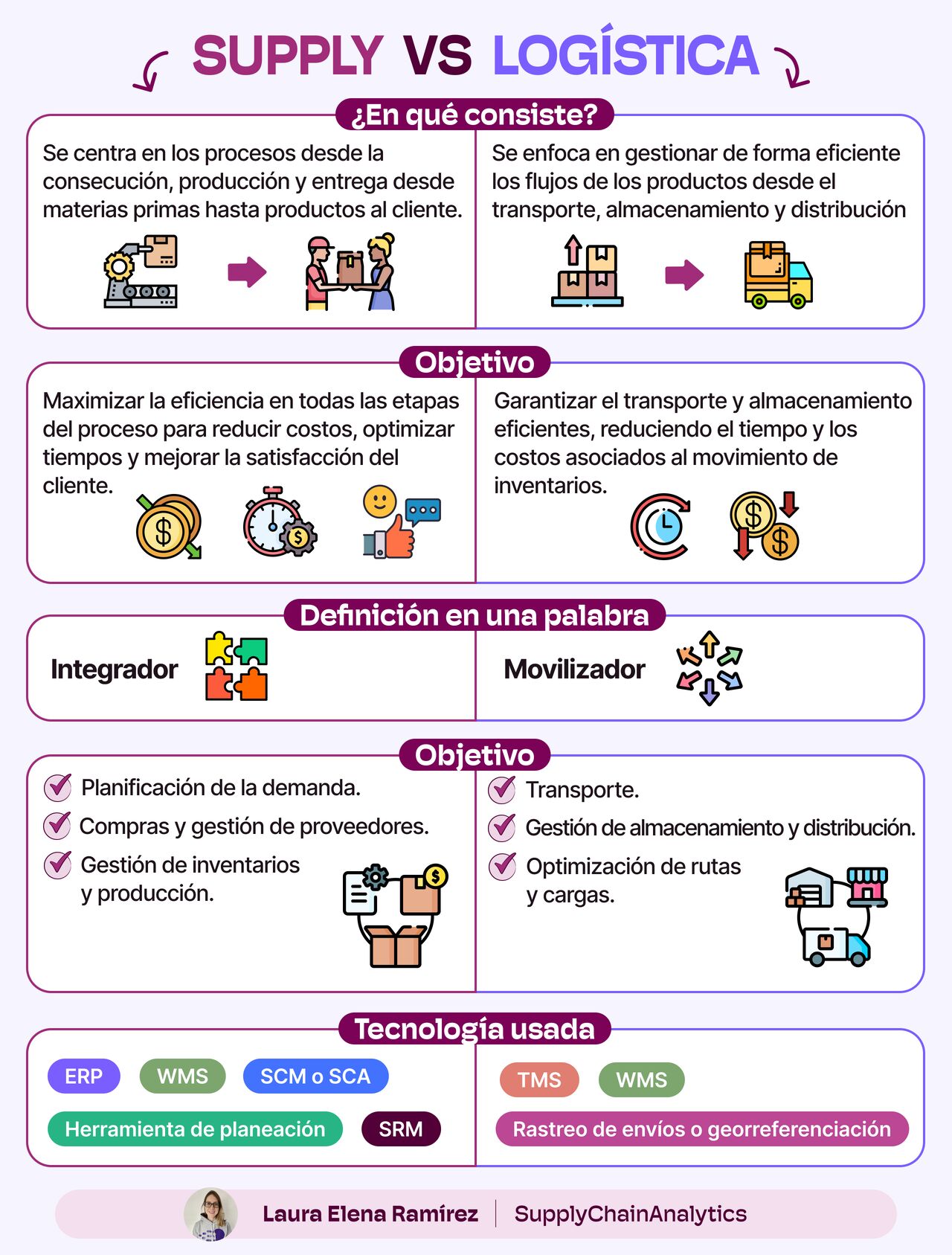
Logistics covers the physical flow of the product and associated information: From the moment something leaves a source until it reaches its destination. Transportation, warehousing, operation of distribution centers, picking, packing, returns, visibility of deliveries. All of that is logistics.
Its nature is predominantly operational and tactical. The focus is on meeting specific service levels: full order, on time, in good condition. A WMS that manages the warehouse, a TMS that optimizes routes, a tracking system that provides visibility in real time. These are the tools of everyday logistics.
The objective of logistics is usually summarized in a rule that the industry knows by heart: right product, right quantity, right place, right time, right cost, right level of service. Useful as a summary, but dangerous if read as a separate checklist.
Each of these “correct” ones depends on decisions that are made outside the logistics field. The correct cost is not defined only by the transport operator. The right time isn't just a route issue. That's where the distinction begins to appear with The supply chain.
The metrics that measure logistics performance are the OTIF, the Fill Rate, the order cycle time and the cost of transportation per unit. If those metrics are doing well on a sustained basis, logistics are working. If they go well one month and badly the next, the problem is probably higher up.
.jpg)
The supply chain is the complete network: suppliers of raw materials, manufacturers, distributors, logistics operators, customers. Everything that intervenes in the life cycle of a product, from when the first input is extracted or purchased until the product reaches the end user.
Its scope includes the selection and management of suppliers, purchasing and procurement, demand planning and S&OP, production planning, manufacturing and distribution network design. Also, risk management, which in recent years has gone from being a conference topic to being a real operational priority.
The difference in scope implies a difference in horizon. Logistics works in the short and medium term. The supply chain designs and coordinates the network so that it works well in the medium and long term, and to withstand when something fails.
Supply chain objectives operate on another layer. It's not just that the order arrives well: it's that the supplier structure is robust, that the total cost of the network is competitive, that the company can respond when a key supplier is out of the game or when demand suddenly moves by 30%.
The relevant metrics change: inventory rotation, cash-to-cash cycle, total cost of the chain, capacity to respond to disruptions. These are metrics that are not seen on a daily operations dashboard, but that determine if the business is viable in two years.
The clearest difference is one of scope and level of decision.
Logistics can optimize locally and do it well. Reduce the cost on a specific route, improve order preparation time, lower the rate of delivery incidents. That work has value. The problem appears when this local optimization is done without aligning it with what is happening in purchasing, production or sales. A warehouse that works perfectly with a supplier that is about to fail is a good example of disconnected supply chain logistics.
The supply chain exists exactly to avoid that: so that local decisions are aligned with the logic of the entire system.
Although the scope is different, the final purpose is consistent: that the right product is available to the customer at the right time and place, at the lowest possible cost. And neither of them solves that separately.
Both disciplines rely on accurate information. Both require coordination between sales, production, purchasing and finance. Both have a direct impact on the level of customer service and both benefit from technology: real-time visibility, automation, analytics applied to operational decisions.
The relationship between the two is from one side to the whole. Logistics is a subsystem within the supply chain. The supply chain designs the system; logistics executes the movement of products within that system. When the two levels are well connected, the result is noticeable. When they are not, symptoms appear in the Fill Rate, in the inventory, in the cost of emergency transportation.
A 3PL operator who manages the logistics of an e-commerce customer can have the warehouse perfectly synchronized, with tight picking times and optimized last-mile routes. If that customer grows 40% in Q4 without warning, and there is no supply chain decision that has anticipated volume with suppliers, a well-managed warehouse is useless: there is no stock to move.
At the supply chain level: selection of suppliers and manufacturers, planning purchases according to expected demand, design of the distribution center network, alliances with last-mile operators.
At the logistics level: receiving merchandise, managing inventory, preparing and packaging orders, assigning routes, tracking deliveries, managing returns.
The pressure here is twofold: perishables with tight time windows and seasonal demand that requires planning the supply of raw materials well in advance. A forecast error that is mistransferred to the agricultural supplier can become a supply problem that no transport optimization will solve.
At the supply chain level: supply of raw materials, production scheduling according to seasonal demand, coordination with packers and distributors.
At the logistics level: transportation of raw materials to the plant, cold storage, distribution to supermarket chains, time control to ensure freshness.
In environments with OEM orders and just-in-time deliveries to customer production lines, the margin of logistical error is almost zero. A delay of hours can stop a line. But the underlying risk is not logistical: it lies in the management of component suppliers and in the chain's ability to absorb order variations without breaking committed deadlines.
At the supply chain level: integration with component suppliers, production planning, coordination of international shipments.
At the logistics level: international transport planning, regional warehouse management, just-in-time delivery assurance.
Logistics management focuses on designing and improving transportation, storage and distribution processes. The classic technological stack: WMS for warehouses, TMS for transport, tracking systems for visibility.
Supply chain management integrates demand planning, S&OP, production planning, supplier management and network design. It requires coordination between multiple companies and an end-to-end view of the flow of materials, information and capital. This is the most difficult job, because it involves aligning decisions that belong to different organizations with different incentives.
La predictive analytics in supply chain and artificial intelligence are changing possibilities on both levels, but real value appears When logistics operation data fuels supply chain decisions. A team that crosses sales, inventories, supplier data and external variables (climate, inflation, market behavior) can anticipate disruptions. The one who doesn't do it continues to manage with a rear-view mirror.
In Datup we work exactly at that point of intersection: we integrate the data from your ERP, WMS and TMS with external variables to generate Demand forecasts and suggested inventory that your team can turn into concrete purchasing decisions, without relying on Excel or manual models.
Logistics plans and controls the flow of products from their origin to the end customer: transport, storage, distribution. The supply chain is the broadest concept: the entire network of suppliers, manufacturers, distributors and customers involved in the full life cycle of the product. Logistics is a part of that network.
Logistics manages the physical movement of the product with an operational approach. The supply chain coordinates the entire network with a strategic approach. In practical terms: logistics optimizes how the product moves; the supply chain decides with whom, where and when it is produced, purchased and distributed.
The objectives of logistics revolve around complete and timely deliveries, reduction of operating costs and inventory control. Those in the supply chain are more structural: product availability throughout the network, integration of processes between companies, minimization of total cost, resilience to disruptions and alignment with business strategy. Both point to the same final result, but from different layers of the system.

Laura Ramírez is a business and operational planning supply chain strategist with more than 15 years of experience helping companies make better decisions based on data.

.jpg)